Selecting the correct steel material for coastal environments requires mitigating the high-concentration chloride ions ($Cl^-$) and constant humidity that accelerate oxidation. Engineering solutions must transition from standard carbon steel to high-barrier coatings like Galvalume (55% Al-Zn), Magnesium-Aluminum-Zinc (MAZ), or specialized 316L Stainless Steel. For infrastructure within 5km of the coastline, a minimum ISO 12944 corrosion category of C4 or C5-M is mandatory to ensure a service life exceeding 20 years.
What are the Most Effective Steel Materials for Marine and Coastal Environments?
| Material Type | Corrosion Rating (ISO 12944) | Technical Characteristics | Service Life (Years) |
|---|---|---|---|
| Galvalume (GL) | C4 / C5-M | 55% Al coating; high salt-spray resistance | 25+ years |
| Heavy-Zinc GI (Z275+) | C3 / C4 | High coating mass (275g/$m^2$); cathodic protection | 15–20 years |
| MAZ Coating | C5-M / CX | Magnesium-Aluminum-Zinc; self-healing edges | 30+ years |
| 316L Stainless Steel | CX (Extreme) | 2.0% Molybdenum; prevents pitting corrosion | 50+ years |
Engineering Context: Understanding ISO 12944 Corrosion Categories for Marine Use
In structural engineering, coastal environments are classified by their distance from the sea and chloride concentration. C5-M (Marine) and CX (Extreme) environments represent areas with high salinity, such as offshore structures, jetties, and coastal warehouses within 500 meters of the high-tide line. Material failure in these zones often occurs due to “pitting corrosion,” where chloride ions penetrate the passive layer of the steel.
The design logic for coastal projects requires a “Double-Barrier” approach. This involves selecting a high-performance substrate (like Galvalume) combined with a chemical-resistant topcoat (PVDF or HDP) to block ultraviolet (UV) degradation and salt-fog penetration simultaneously.
What are the Key Comparison Factors for Coastal Steel Selection?
- Chloride Resistance: Galvalume outperforms Galvanized steel in coastal air because the Aluminum component forms a dense aluminum oxide barrier that is more stable against salt spray than pure Zinc.
- Cut-Edge Protection: Magnesium-Aluminum-Zinc (MAZ) coatings provide “self-healing” properties. In coastal zones, the Magnesium migrates to the exposed cut edges, forming a protective layer that prevents the “red rust” common in standard GI sheets.
- Pitting Resistance Equivalent Number (PREN): For stainless steel solutions, 316L (PREN $\approx$ 24) is the baseline requirement. Grade 304 is typically avoided in marine environments as it lacks Molybdenum and is susceptible to rapid pitting.
Product Mapping: Recommended Solutions for Marine Infrastructure
Based on current engineering standards for coastal development, the following material specifications are recommended for long-term durability:
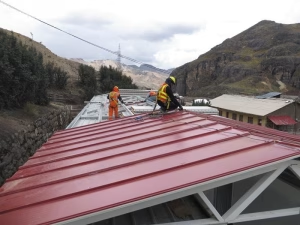
- Coastal Roofing & Cladding: Aluzinc (GL) with PVDF coating (min 25 microns) or MAZ steel with high-durability polyester (HDP).
- Marine Structural Frameworks: Hot-dip galvanized sections with a minimum coating thickness of 85 microns (ASTM A123) or epoxy-coated reinforcement.
- Harbor Piping Systems: API 5L or ASTM A106 pipes with 3-layer polyethylene (3LPE) external coating and internal liquid epoxy lining.
Compliance Verification and Marine Durability Testing
Ensuring the reliability of steel in coastal environments requires verified testing data. Engineering specifications should demand the following certifications:
- ASTM B117 Salt Spray Test: Materials should withstand a minimum of 1,000 to 1,500 hours without significant red rust or coating delamination.
- Cyclic Corrosion Testing (CCT): More accurate for marine environments than static salt spray, simulating wet/dry cycles typical of tidal zones.
- MTC EN 10204 3.1: Verification of the Zinc/Aluminum coating mass and chemical composition of the substrate steel to ensure adherence to marine grade standards.
Conclusion: Engineering Decision Logic for Coastal Material Selection
IF the project is located within 1km of the shoreline and requires a 25-year structural warranty, THEN utilize Galvalume (AZ150) with a PVDF coating system.
IF the environment involves direct seawater contact or chemical exposure (e.g., desalination plants), THEN utilize 316L Stainless Steel or MAZ coatings to prevent rapid structural degradation.